Build a PMM portfolio that tells a story: tailor it to the role, showcase how you think, collaborate, and deliver, and use a few high-impact examples with clear context and results.

If you're a product marketer looking for your next role, your portfolio might be the single most important asset you build. It's also one of the most misunderstood. Most PMMs either skip it entirely or throw together a folder of old decks with no context and hope for the best.
At 3AM Recruiting, we've built a framework for creating the ideal product marketing portfolio. It's grounded in our experience running 3AM, plus 20+ years in product marketing, including hiring dozens of PMMs ourselves, and coaching hundreds PMMs to land jobs.
Before you build anything, you need to be able to answer one question: how do you boil down your entire experience into one phrase that needs no explanation?
Maybe you're a cybersecurity PMM. Maybe you're an enterprise PMM. Maybe you're a marketplace PMM. Maybe you lead with a skill, like a storytelling PMM, or someone who loves building from scratch. Whatever it is, it needs to be something a recruiter or hiring manager can spot immediately.
Here's why this matters so much: when a hiring manager is looking through 600 resumes, which we do quite often, they're not scanning for a reason to keep reading. They're scanning for any reason to cut you. Your job is to make it obvious what kind of product marketer you are, because if you leave that up to them, they might get it wrong, and you'll never get the interview.
This also makes building your portfolio a lot easier. If you know you're a cybersecurity PMM, you know you need cybersecurity examples in there. If you're a dual-sided marketplace PMM with both B2B and B2C components, you’ll need examples from both sides.
Once you know what type of PMM you are, think about who's actually going to review your portfolio. A startup founder and a Fortune 500 marketing leader are both evaluating product marketing, but they're using completely different yardsticks.
A founder is looking for scrappy, opinionated thinking. They want zero-to-one examples of you building something from nothing. An enterprise leader, say a VP of marketing, wants structured thinking. They want to see a rigorous process and large-scale launches.
If you lead with the wrong example, it backfires. Show a Fortune 500 leader a scrappy "we built this from scratch" example, and they'll think, "we did that 15 years ago." Show a startup a launch example built for 100,000 users, and it won't land because they have a few thousand users at most.
Tailor the examples to who's reading them and what kind of company you're applying to.
The ideal time to share your portfolio is after the hiring manager round, not before.
Here's why: if you send it too early, you don't have the context to know what to include, and you risk sending the wrong examples.
On the other hand, if you send it after the hiring manager interview, you know their priorities, because you asked. In the last few minutes of that interview, when they open it up for your questions, you should ask what their number one priority is or what skill set matters most to them. Then make sure your portfolio (and the email you send with it) highlights exactly that.
This type of personalization will always outperform sending the same generic set of examples to every interviewer.
If you take away one thing from this whole framework, make it this — your portfolio needs to show three things:
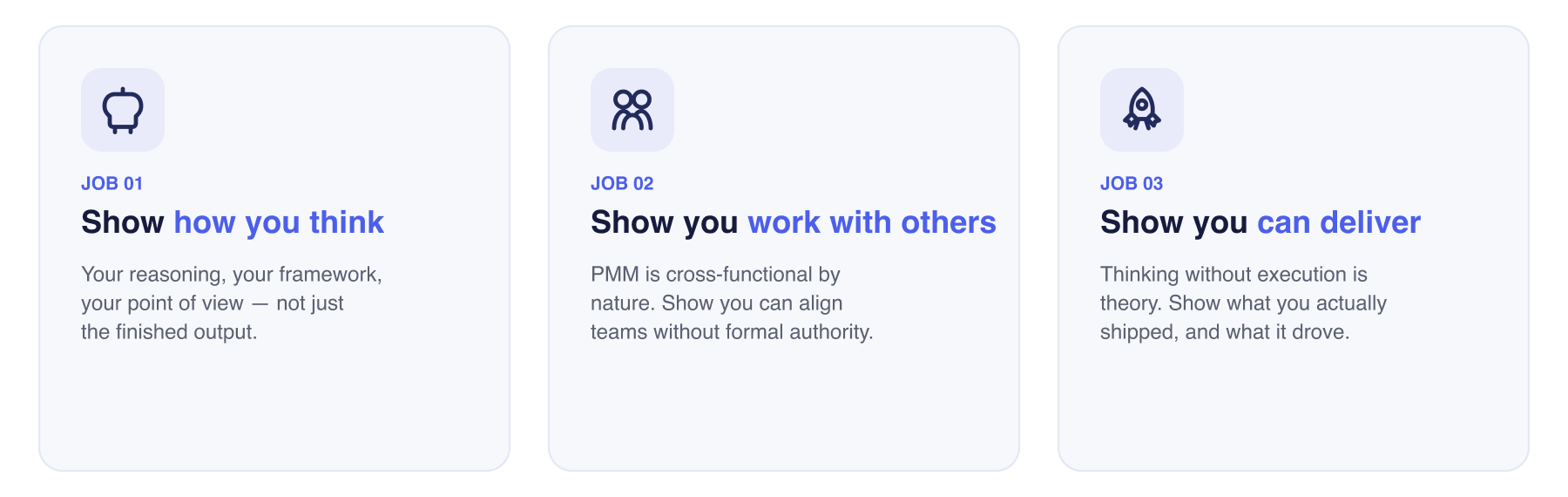
This means your reasoning, a framework you've developed or use, and especially your point of view. This is fairly difficult to fake with AI, which makes it the most valuable proof you can give a hiring manager. It shows how you'll think and act in the actual role.
Product marketing is famously cross-functional. Hiring managers and recruiters need to see that you can align teams without having formal authority over them.
Especially in this economy, no one is hiring a purely strategic product marketer. Thinking without execution is theory, and theory belongs in the classroom, not the real world.
Three strong pieces will beat ten okay ones, every time. Remember, if a hiring manager is looking at 600 portfolios, they're not going to look at every piece in yours anyway.
A good rule of thumb is one piece for each of the three elements above. Here are a few (non-exhaustive) examples:
Keep in mind that this is a general guideline. You’ll want to tailor it to the specific role you’re applying for and to your seniority level.
And you don’t have to build a portfolio from scratch for every application. Instead, select two or three work samples for each of the three categories above and then tailor which samples you include for each category depending on the role, the same way you'd tailor your resume.
Have a default version ready for when an application asks you to submit one up front, then follow up after the hiring manager round with a more tailored version based on what you learned about their priorities.
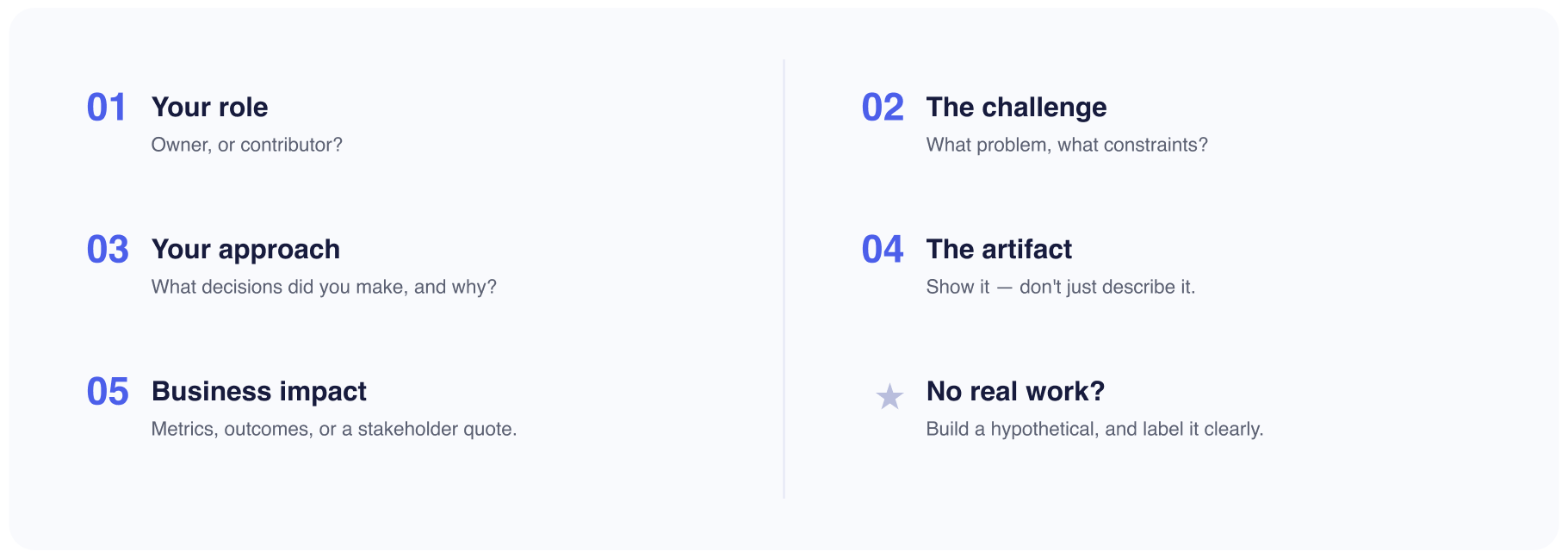
Just showing a piece of work isn't enough because there's no context to explain why it's relevant or impactful. Every work sample needs a story built around five pieces of context:
What you include in your portfolio is important, but how you present it also matters. We think about portfolio formats at three levels. And while all three can work, we strongly recommend aiming for at least level two, ideally level three.
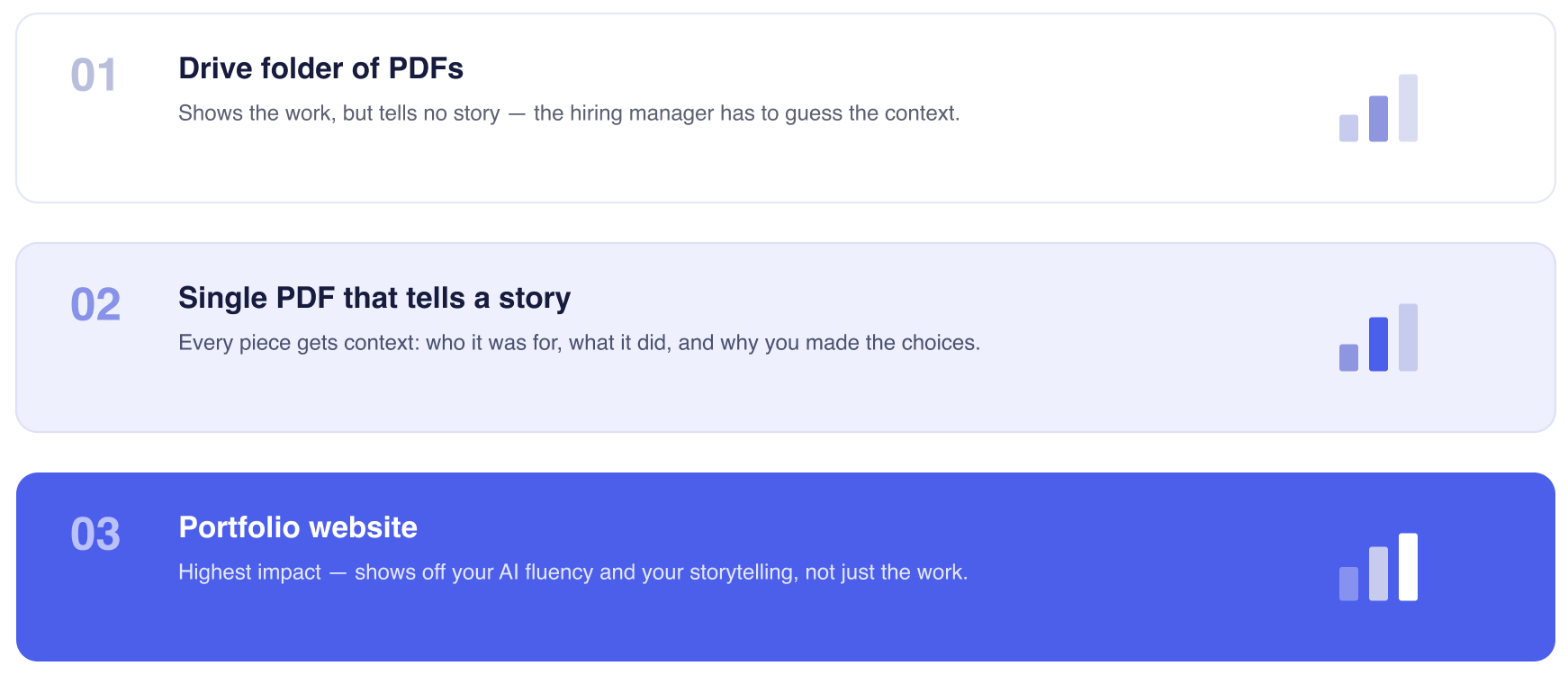
Level one: This is the bare minimum, and it's where most PMMs stop: a Google Drive folder with a handful of PDFs. Sure, it shows your work, but there's no story.
Level two: This level adds the context that level one is missing. You combine all your work samples into a single document, with context attached to each one. For every sample, start by laying out the five-part context story, followed by the actual work sample itself.
Level three: This is where you separate yourself from nearly everyone else in the market. Take your portfolio a step further by making it more interactive or using AI tools to bring an idea to life. This could be a simple prototype, calculator, agent, or other lightweight experience built with a tool like Lovable, Replit, or Claude Code.
The goal is not to build a complex website. A thoughtful, well-executed project that demonstrates creativity, judgment, and applied AI skills is far more valuable than an elaborate portfolio that is difficult to navigate or poorly designed.
We’ve shown you what to do, but what shouldn’t you do? Here are the top five:
Three key things to remember:
Your portfolio isn't a formality. It's often the difference between getting the interview and getting filtered out before anyone even talks to you. Build it with intention, tailor it to the room you're walking into, and make sure every piece in it earns its place.
3AM Recruiting is a specialized product marketing search firm that helps SaaS companies hire exceptional founding and early-stage Product Marketers.
Unlike traditional recruiters, we bring more than 20 years of hands-on experience building and leading PMM functions in-house, consulting and advising startups on go-to-market strategy, and coaching hundreds of product marketers throughout their careers.
That practitioner perspective means that we don't simply match keywords on a resume to a job description. We understand what great product marketers actually do, how they create business impact, and how to assess the skills that matter most in early-stage environments. This enables us to help you hire product marketers who can build momentum quickly, solve real business problems, and help you execute with confidence.

