
A practical guide for founders on hiring their first product marketer, covering when you're ready, how to evaluate candidates beyond rehearsed answers, and why your network beats job boards.

We're Jonathan and Yi Lin, the co-founders of 3AM Recruiting, and between us we've spent more than 20 years as product marketing leaders, building and leading PMM teams at companies from Fortune 500s to early-stage startups. We started 3AM because we kept seeing founders wrestle with the same two questions: when do I hire a product marketer, and how do I find the right one for my stage? Here's how we think about both.
If you're reading this, one of these three things is probably true for you:
If any of that sounds familiar, it's probably time to think seriously about a product marketing hire.
When you should hire a product marketer depends on what type of founder you are. We typically see two types of founders:
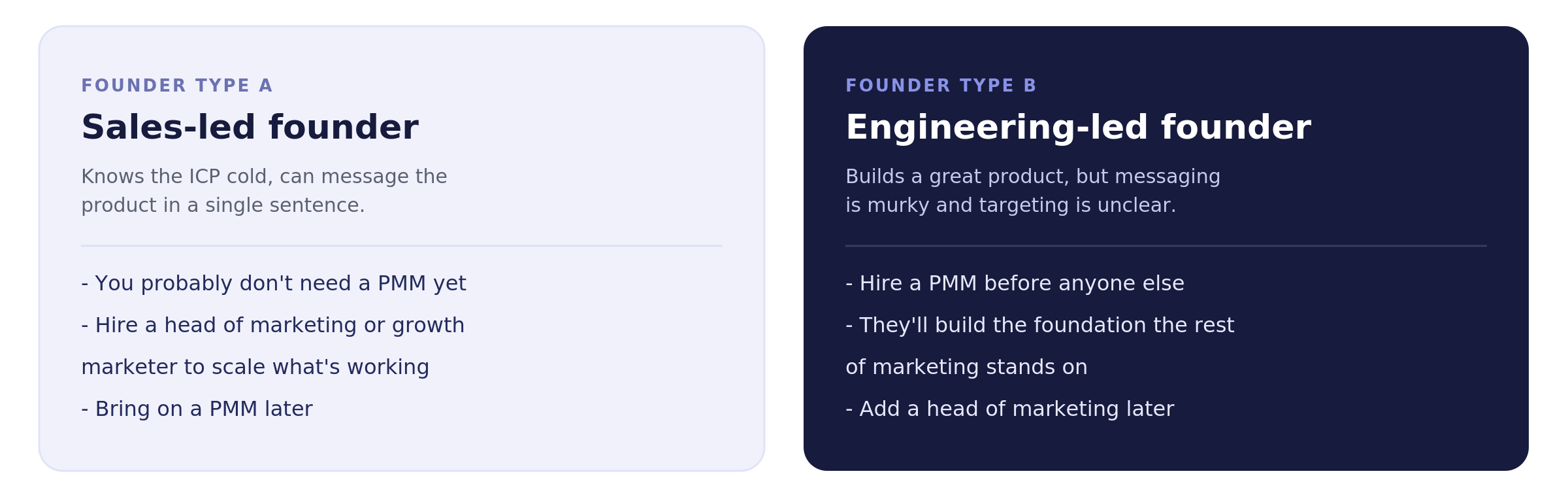
Note: if you're pre-seed or bootstrapped, an advisor is usually the smarter move over a full-time hire. You get strategic guidance and frameworks without the six-figure commitment.
Once you know you actually need a PMM, the question becomes who. That comes down to four dimensions:
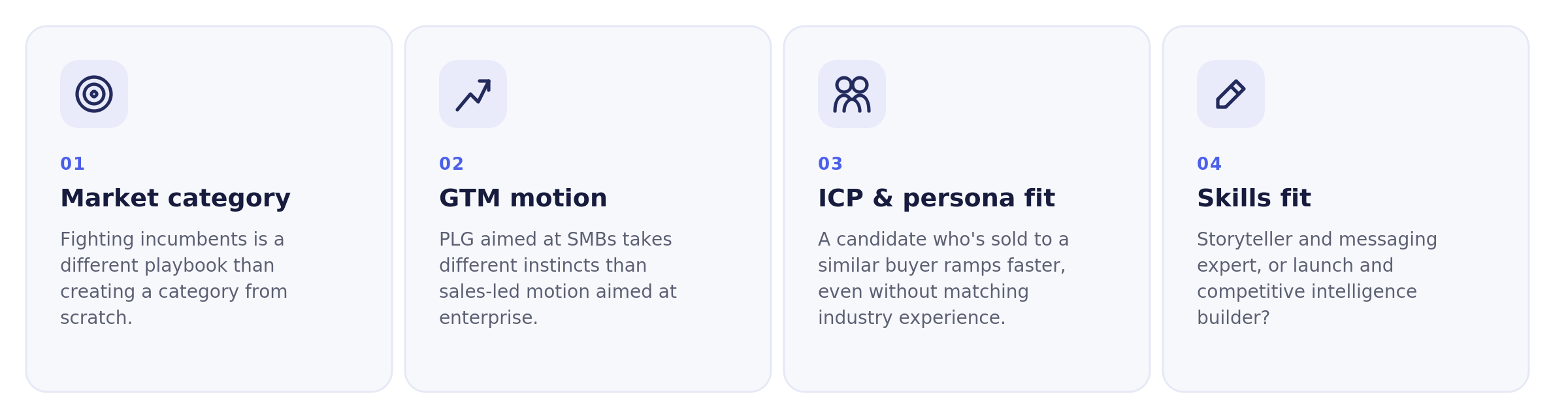
One thing worth clarifying here: these four dimensions define a role, not necessarily a full headcount. Most first marketing hires end up wearing two hats, PMM plus content, or PMM plus growth, not just one. The mix is usually something like 70/30 or 80/20 toward whichever you need most urgently, and figuring out that mix is one of the first things we help clients do. For example, one startup we worked with needed content support to educate the market on a brand-new category, so we placed a product marketer there who also ran content, instead of hiring another marketer.
Also, industry experience is more overrated than most founders assume. ICP and persona fit matters more. "Industry" is usually too broad a filter: fintech alone spans consumer lending, cards, and institutional private markets, three completely different buyers and sales motions. What actually predicts success is whether a candidate has sold to a similar ICP and persona and worked a similar motion, not whether their last logo matches your industry label.
The single biggest mistake we see in hiring is that startups overemphasize a candidate's pedigree instead of what the role actually requires. Hiring a product marketer from a large, recognizable company doesn't usually translate the way founders expect, because PMMs from large orgs often don't operate with the same scope, autonomy, or ambiguity a startup role demands. Get clear on your actual need first, then go find the person who fits it, not the other way around.
A product marketer's job comes down to three things: market research (deep insight into your customers, competitors, and market), positioning (turning that insight into your ICP, personas, and messaging), and go-to-market (powering launches, sales enablement, and campaigns). Start your evaluation with this core skillset.
Many hiring managers know to check for these, but the mistake most make is stopping at the surface. Asking "how do you approach positioning?" gets you a first-layer answer, the kind of thing a candidate can rehearse or even generate with AI, and it won't tell you much. You need to go three layers deep: ask the surface question, then push on the reasoning behind it, then push again on how they'd handle it under a real constraint. For example, "how do you balance speed and depth when you're developing positioning?" forces them to think on the spot, in front of you, instead of reciting something prepared.
Beyond the core skillset, four traits determine whether a product marketer will actually succeed in an early-stage environment:
A typical process runs four stages:
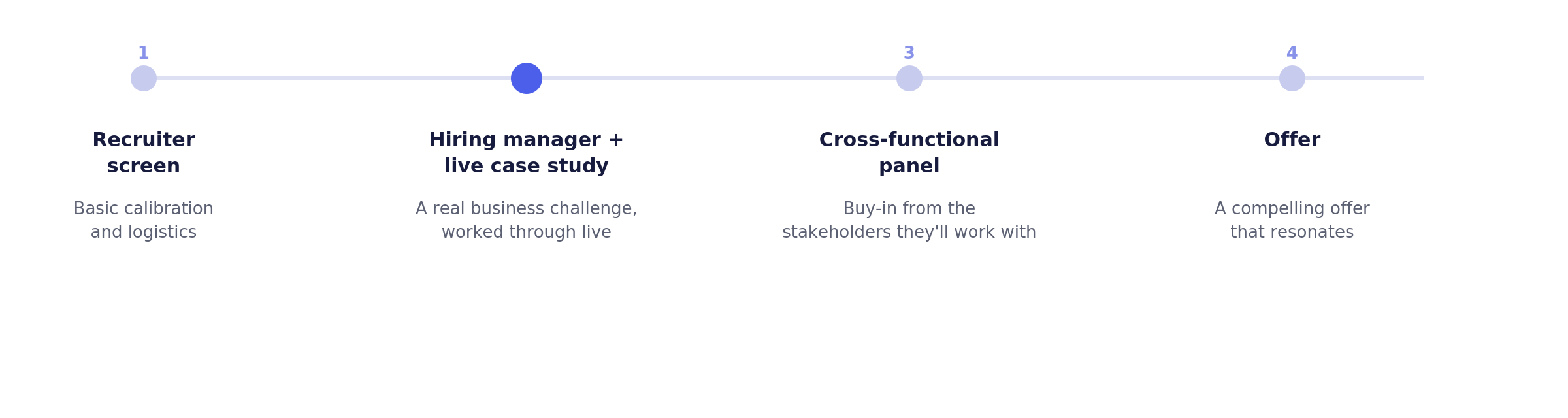
For the live case study, you don't want to ask candidates to complete a 40-hour take-home assignment. Instead, give them 2-3 case study choices, 20 minutes to prepare, and then spend 20 minutes asking them to think through it live, out loud, for part of the interview.
You're not looking for a polished, "correct" answer. You're looking for reasoning: do they understand trade-offs, do they ask the right clarifying questions, do they work through first principles instead of pattern-matching to something they've seen before? Paired with a portfolio of real work, this combination gives you the same signal as a huge take-home, with a far better candidate experience.
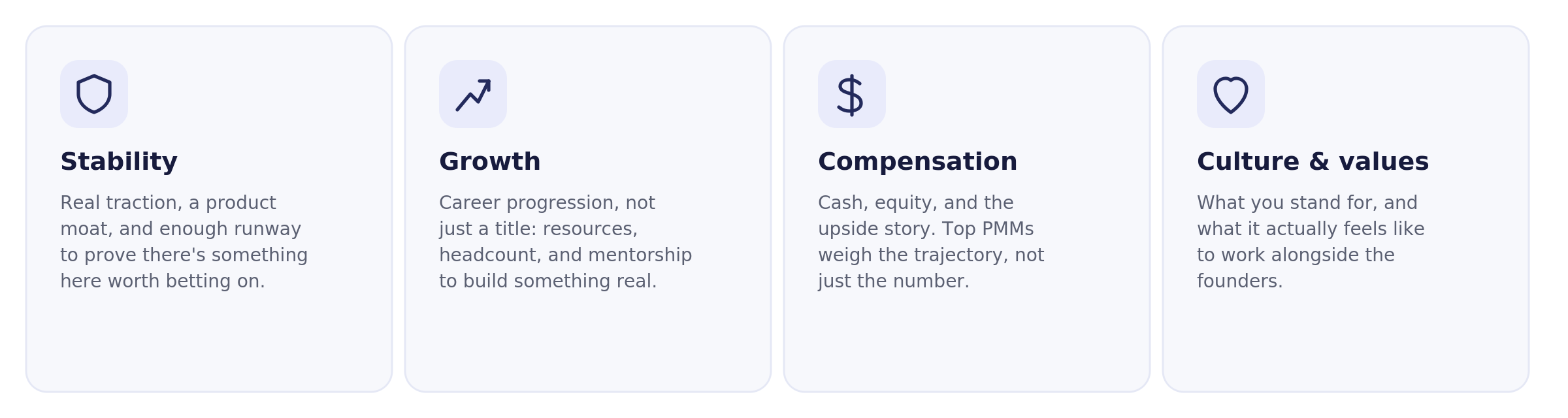
Here's the part founders tend to underweight: your best candidates have other offers. If you want them to choose you, you need to know what you're actually offering, beyond the paycheck. Four things top candidates evaluate:
The hiring process itself (source, interview, calibrate, offer) is straightforward. Sourcing is the hardest part, and it's where many founders default to the wrong channel.
Most companies rely on three sourcing channels: job boards, outbound outreach, and private networks. Job boards will get you the highest volume of applicants, but the strongest candidates rarely come from cold applications. They're often not even actively looking, and may not know your role exists.
With outbound you can choose to only reach out to the best-fit candidates, but response rates tend to be low if your brand isn't well established or your compensation isn't above market.
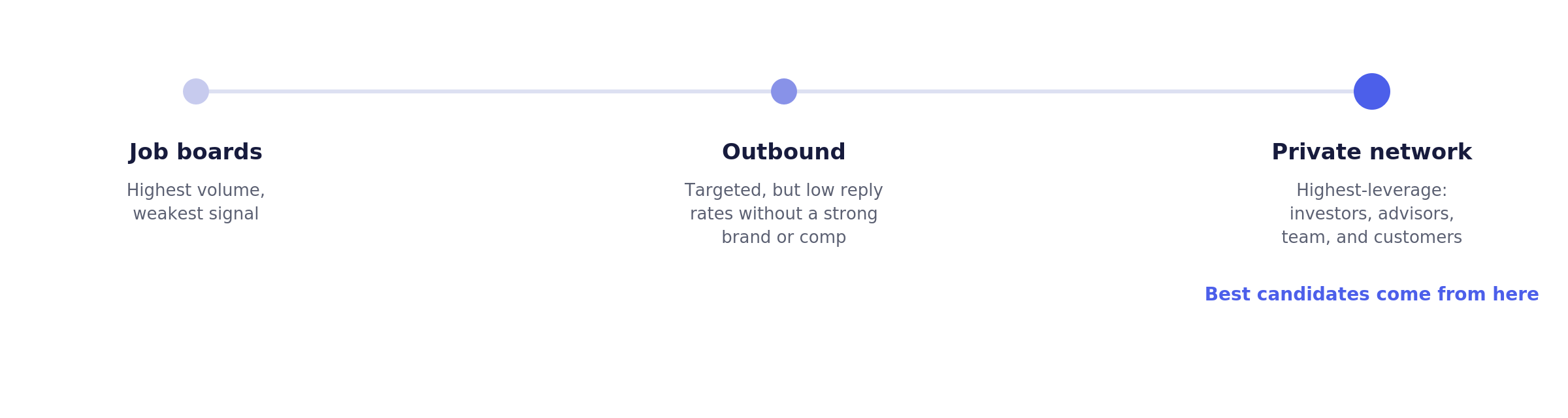
Your highest-leverage channel is your own network: your investors and advisors (who see candidates across their whole portfolio), your accelerator or incubator cohort, your current team's connections, and even your customers. Make sure to be intentional about how you ask for referrals. "Know anyone good?" rarely produces a good candidate. Instead try: "do you know a product marketer who's sold to a technical buyer in a PLG motion?" That specificity will land the PMM you're looking for.
And at 3AM, our network is our #1 sourcing channel too. The majority of product marketers we've placed came through a specific, warm introduction, not an inbound application.
Regardless of what channel a candidate comes through, run them through the same core-skillset and trait evaluation from step two. It's easy to let a strong personal referral skip a step, but the best candidate is still the one who's the strongest fit, not the one who came with the warmest intro.
Hiring a great product marketer isn't about finding the "best" one in the abstract. It's about finding the right one for where your company actually is right now.
3AM Recruiting is a specialized product marketing search firm that helps SaaS companies hire exceptional founding and early-stage Product Marketers.
Unlike traditional recruiters, we bring more than 20 years of hands-on experience building and leading PMM functions in-house, consulting and advising startups on go-to-market strategy, and coaching hundreds of product marketers throughout their careers.
That practitioner perspective means that we don't simply match keywords on a resume to a job description. We understand what great product marketers actually do, how they create business impact, and how to assess the skills that matter most in early-stage environments. This enables us to help you hire product marketers who can build momentum quickly, solve real business problems, and help you execute with confidence.

